June 21, 2026
Jorge Alves
SOURCING GUIDE Category: Private Label Reading time: 7 min
Most brands use these two terms interchangeably. They are not the same thing. Choosing the wrong model at the wrong stage costs you time, money, and flexibility. Here is how to tell them apart and which one is right for you.
You have decided to add metal home accessories to your range. Brass trays, copper candle vessels, decorative bowls. The next question is how.
You will hear two terms from every manufacturer you speak to. Private label. White label. They sound similar. They are used interchangeably everywhere. But they describe two completely different business arrangements.
Getting this wrong at the start could be a mistake. You either overspend on customisation before you have proven demand. Or you launch a stock product that three other brands in your market are also selling.
This guide explains what each model actually means, what it costs, and which one makes sense at your stage.
1. The simplest way to understand the difference
Think of it this way.
White label is like buying a ready-made suit off the rack and putting your name tag on it. The suit already exists. Anyone can buy the same one. Your name is on it but the product is not yours.
Private label is like having a suit made to your measurements, in the fabric you chose, with the details you specified. Nobody else has that suit. It was just made for you.
Both are valid. Both have a place. The question is which one fits where you are right now.
2. White label: what it is and when it makes sense
What it means
The manufacturer has a range of existing products. Standard shapes, standard sizes, standard finishes. You choose from that range. You apply your branding through a label, a sticker, a hang tag, or a simple engraving of your logo. The product ships under your brand name.
The product itself is not exclusive to you. Another brand can order the same brass tray in the same finish from the same manufacturer and put their name on it.
The numbers
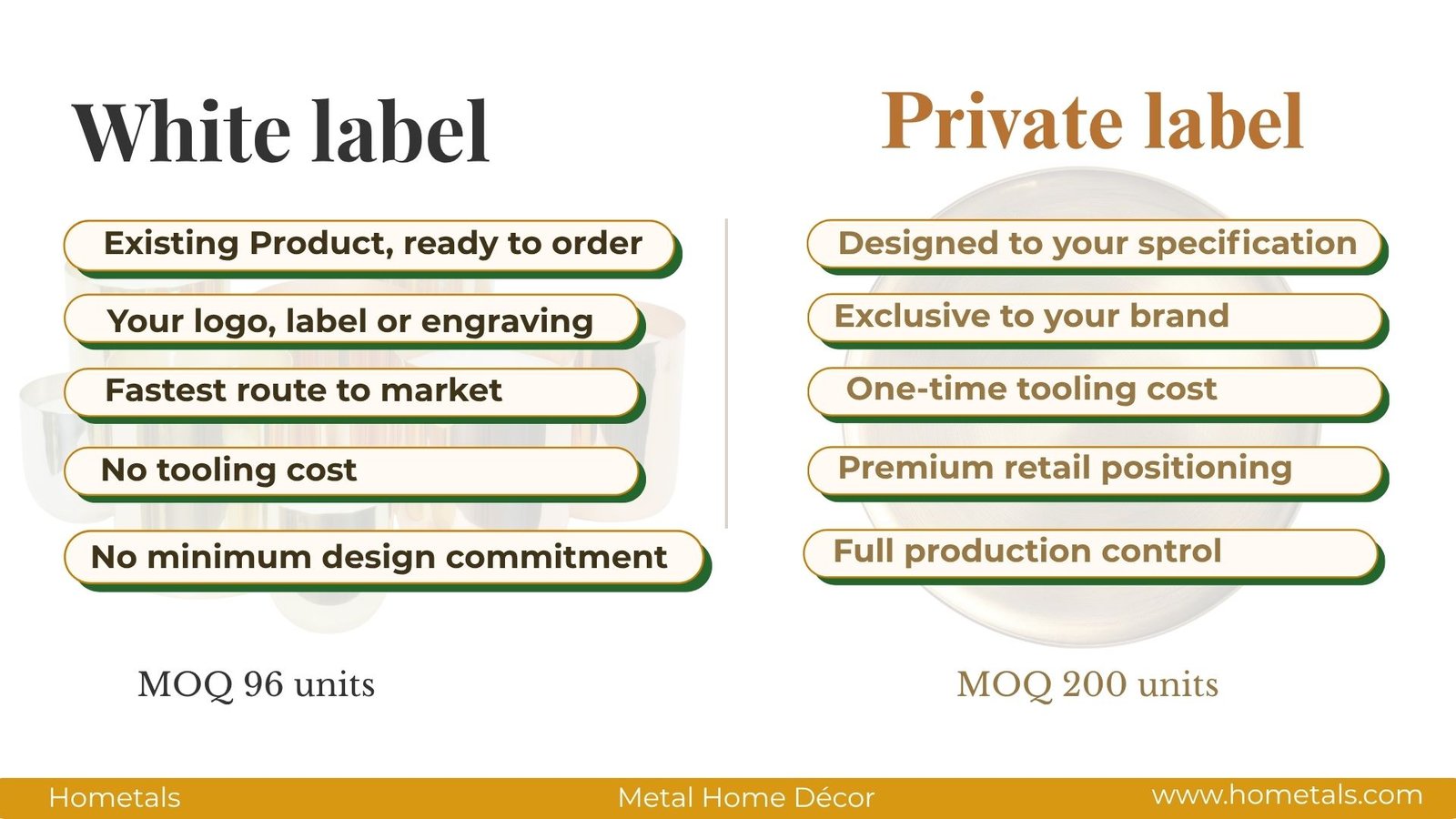
At Hometals, white label starts at 96 units per product. That is a low risk entry point. You are not committing to large volumes before you know how the product sells.
Lead time is short. The product already exists. There is no tooling, no sampling for a new shape, no back and forth on specifications. You approve the finish, confirm your branding, and production begins.
When white label is the right choice
- You are launching your first metal range and want to test the market before committing to custom products.
- Your brand differentiation comes from curation, styling, and narrative rather than unique product design.
- You need to move fast. A trade show, a retail listing, a seasonal launch with a tight deadline.
- Your budget is limited and you want to minimise upfront investment.
- You sell in a market where your competitors are not using the same manufacturer.
White label is not a shortcut or a compromise. Many successful home décor brands run entirely on white label products. The brand is the product. The product is just the vehicle.
3. Private label: what it is and when it makes sense
What it means
You brief the manufacturer on what you want. The dimensions, the metal, the finish, the weight, the lid style, any engraving or surface detail. The manufacturer produces it to your specification.
That product belongs to you. The tooling is commissioned for your design. No other brand can order it.
The numbers
At Hometals, private label starts at 200 units per product. The higher minimum reflects the tooling and sampling process involved in producing something new.
Lead time is longer on the first run. You need a sampling phase before production begins. Expect 2 to 4 weeks for samples, then 4 to 8 weeks for production once samples are approved. After the first run, reorders are faster because the tooling and specification already exist.
Tooling costs depend on complexity. A simple cylindrical vessel with a custom diameter is at the lower end. An intricate shape with surface relief patterns is at the higher end. Your manufacturer should give you a one-time tooling cost that is separate from the per-unit price.
When private label is the right choice
- You have already proven demand with a white label product and want to move to something exclusive.
- Your brand positioning depends on product uniqueness. You cannot afford to have competitors selling the same vessel.
- You are pitching to premium retailers who ask whether the product is exclusive to you.
- You have the volume to justify the tooling investment across the production run.
- You are building a long-term product line, not a seasonal experiment.
Private label is not just about exclusivity. It is about control. You control the dimensions, the weight, the finish tolerances, and the details that determine how the product feels in a customer’s hand.
4. Side by side comparison
| White Label | Private Label | |
|---|---|---|
| Product | Manufacturer’s existing range | Made to your specification |
| Exclusivity | Not exclusive | Exclusive to your brand |
| MOQ at Hometals | 96 units per product | 200 units per product |
| Tooling cost | None | One-time cost, varies by complexity |
| Sample process | Not required | Required before production |
| First order lead time | 4 to 6 weeks | 8 to 14 weeks |
| Reorder lead time | 4 to 6 weeks | 4 to 8 weeks |
| Best for | New brands, fast launches, testing | Established brands, retail listings, scaling |
| Risk level | Lower | Higher upfront, lower long-term |
5. The mistake most brands make
They start with private label.
It sounds more serious. More premium. More like a real brand. So they invest in custom tooling before they have sold a single unit.
Then the product lands. And the market reacts differently than expected. The shape is wrong. The size does not work for the retail shelf.
Now they are stuck with tooling they paid for and a product that needs to change.
The brands that get this right do it the other way around. They launch on white label. They learn what sells, what size moves fastest, what finish photographs best. Then they take that knowledge into a private label brief and produce something that has already been validated by the market.
White label is not a starting point to be ashamed of. It is market research you get paid for.
6. Can you do both at the same time
Yes. And it is a sensible strategy.
Many brands run a white label core range alongside one or two private label hero products. The white label range covers the breadth of the collection. The private label pieces are the signature items, the ones that go in press kits and retail windows and brand photography.
This approach manages risk without sacrificing brand identity. You have volume across a broad range without over-investing in tooling for products that are still unproven.
7. Questions to ask your manufacturer before deciding
- Which products in your range are available for white label, and what branding options are available on white label products? For a full breakdown of available finishes, see our blog choosing the right finish for your brand..
- What is the tooling cost for a private label brief at my target dimensions, and who owns the tooling after it is made?
- Can I start with white label and transition the same product to private label later once I have volume?
- What is the minimum change required to make a white label product exclusive? For example, a custom finish or engraving that is unique to my brand?
- How do you handle finish consistency between my white label and private label products if they sit in the same collection?
The last question matters more than most brands realise. If your white label and private label pieces are photographed together, the finishes need to read as part of the same family. Ask to see samples side by side before committing.
8. A practical decision framework
If you are just starting out and have not sold metal products before, start with white label. Keep the MOQ low. Learn fast. Reinvest the margin into your first private label brief once you know what works.
If you have an existing range and are adding metal as a new category, white label still makes sense for the first season. Use it to understand how your customers respond to metal specifically.
If you are an established brand with confirmed retail accounts and a clear product brief, go straight to private label. The exclusivity matters at that level and you have enough information to brief correctly.
If you are somewhere in between, a useful test is this. Can you describe the exact product you want in enough detail to brief a manufacturer clearly? If yes, you are ready for private label. If you are still figuring out dimensions, finishes, and use cases, start with white label and use that experience to build the brief.
Hometals offers both white label and private label metal home accessories from Lisbon. White label from 96 units. Private label from 200 units. EU delivery in 2 to 5 days. To see the range or discuss a brief, visit hometals.com or write to jorge@hometals.com.
Author

Jorge Alves is Brand Manager at Hometals, leading client relationships and marketing across Europe. Working directly with the Hometals operations team in Portugal, Jorge helps home décor brands, candle makers, and hospitality buyers source custom metal accessories. From private label brass candle jars to bespoke copper trays - manufactured to specification and delivered EU-ready from Lisbon.