July 31, 2026
Jorge Alves
Minimum order quantities are the number that stops most brands from getting started. Here is what MOQs actually look like when sourcing metal home accessories in Europe – and how to approach them without overcommitting.
MOQ is one of the first questions every brand asks. And it is the one that kills the most conversations before they get started. If you are still deciding between white label and private label, read our guide on private label vs white label metal home décor first.
A buyer reaches out to a manufacturer. The product looks right. The quality looks right. Then they see the minimum order quantity and close the tab.
This happens for two reasons. Either the MOQ is genuinely too high. Or the buyer does not fully understand what MOQ means in practice and how to work with it.
This guide covers both. Real numbers, honest advice, and a clear picture of what sourcing metal accessories in Europe actually looks like from order one.
1. What MOQ practically means
MOQ stands for minimum order quantity. It is the smallest number of units a manufacturer will produce in a single order. It exists because manufacturing has fixed costs. Setting up a production run, preparing materials, applying a finish, running quality checks – these costs are the same whether you order 50 units or 500. The manufacturer needs a minimum volume to cover those costs and make the run viable.
MOQ is not about making your life difficult. It is about the economics of production.
Understanding that changes how you negotiate. You are not asking for a favour when you discuss MOQ. You are having a conversation about production economics. And that is a much more productive conversation to have.
2. What MOQs actually look like in Europe
There is a wide range depending on the manufacturer, the product, and the model you choose.
| Model | Typical MOQ | What drives it |
|---|---|---|
| White label (stock product, your branding) | 96-192 units per product | Finish and branding application setup |
| Private label (made to your specification) | 200-500 units per product | Tooling, sampling, and production setup |
| Large volume factories (Asia direct) | 1000 to 10000 units | Container optimisation and volume economics |
| Artisan or bespoke studios | 10 to 50 units | Higher per-unit cost, no scale benefit |
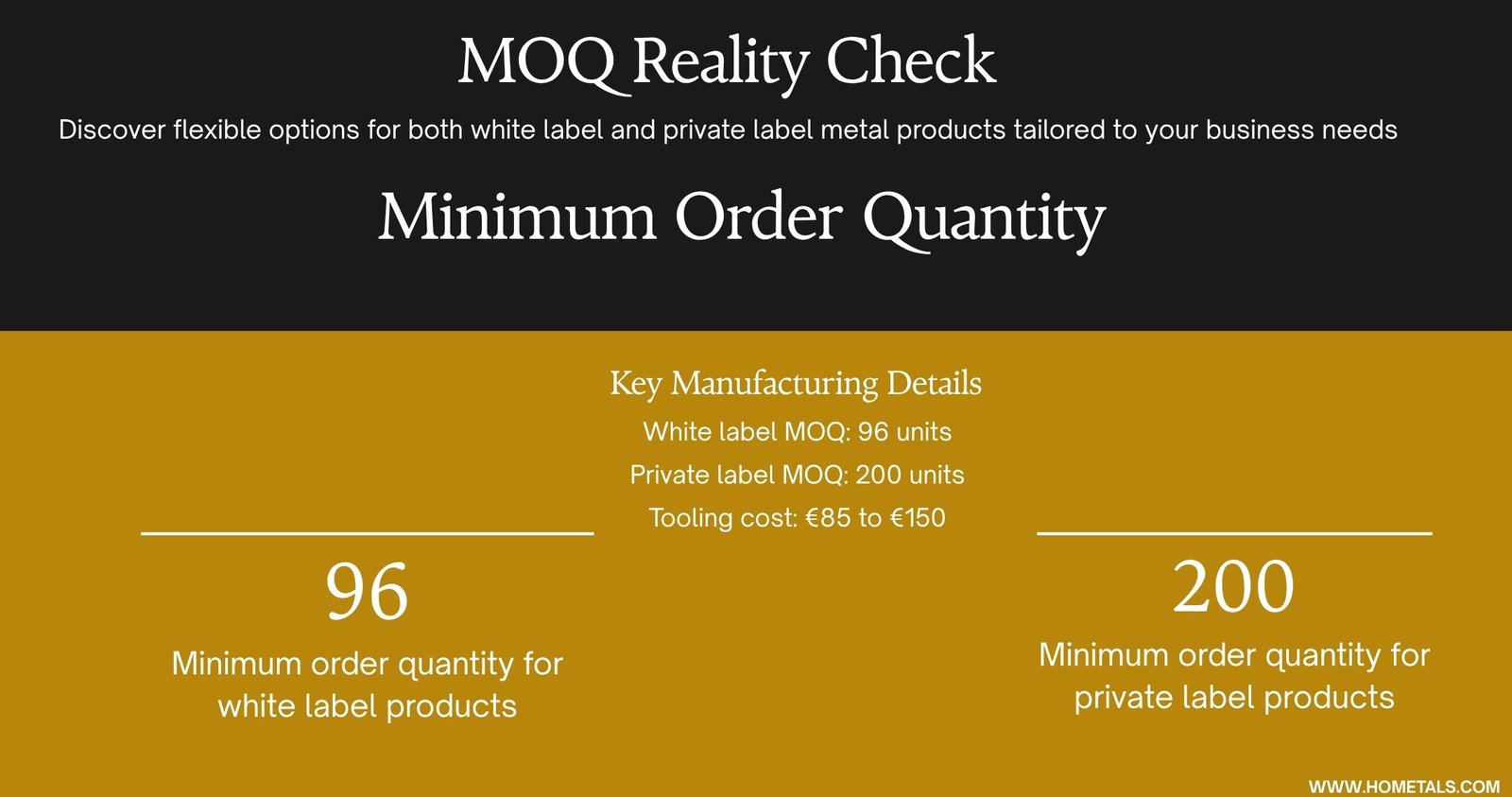
The 96 unit white label MOQ at Hometals is deliberately accessible. For a full breakdown of what white label and private label mean in practice, see our private label vs white label guide. It is designed for brands that are building a range, not yet at scale, and want to test the market without overcommitting to inventory.
The 200 unit private label MOQ reflects the real cost of producing something new. Tooling, sampling, production setup. Below 200 units, that investment does not amortise across the run in a way that works for either side.
3. How samples work before you commit
White label samples
We offer up to two free samples from our existing product range. You pay only for freight. The samples arrive and you assess quality, finish, dimensions, and weight in person before placing an order.
This is the right way to buy. Never commit to a production order on a metal product you have not held in your hands. See our metal candle jar sourcing guide for a full breakdown of what to check before briefing a manufacturer.”
Private label samples
For private label products, samples are charged. This covers the cost of producing a small run to your specification before full production begins.
The sample cost is credited in full against your first production order. So you are not paying twice. You are paying a deposit that confirms commitment on both sides and comes straight off your first invoice.
Freight for samples is always on the buyer. That applies to both white label and private label.
Always request a sample before production. A finish looks different in a photograph than it does in your hand under natural light. One sample prevents “costly surprises” across an entire production run.
4. The real cost behind an MOQ
Brands often focus on the unit count and miss the fuller picture. MOQ is not just a quantity. It is a total commitment. Here is how to think about it properly.
| Cost element | White label example | Private label example |
|---|---|---|
| Units | 96 | 200 |
| Tooling cost | None | 85 to 150 euros (simple jar), 400 to 1500 euros (complex shape) |
| Sample cost | Free (up to 2 units) | Charged, credited against first order |
| Freight | Buyer’s cost | Buyer’s cost |
| Minimum order value | No minimum | No minimum |
| Lead time | 4 to 6 weeks | 8 to 14 weeks (first order) |
There is no minimum order value at Hometals. You are not required to hit a euro threshold. The only commitment is the unit quantity.
For a first white label order of 96 units, your total commitment is the product cost plus freight. No tooling. No sample fee. That is a genuinely low-risk way to enter metal.
For a first private label order, add the tooling cost. For a simple candle jar, that is 85 to 150 euros. For something more complex with surface detail or an unusual shape, it ranges from 400 to 1500 euros. That tooling cost is paid once. Every reorder after that carries no tooling charge.
5. How to think about MOQ relative to your business
You are launching for the first time
Start with white label at 96 units. Pick one or two products. Get them into the market. Learn how your customers respond to metal before committing to larger volumes or custom tooling.
96 units is not a lot. If you sell across DTC and one or two wholesale accounts, that quantity moves in one season.
You have an existing range and are adding metal
White label still makes sense for the first season. Use it to understand which metal products your existing customers respond to. Then use that data to brief a private label run of the top performer.
You have confirmed retail accounts and a clear brief
Go straight to private label. You have enough information to brief correctly. The exclusivity matters at retail level. And the tooling cost amortises quickly across confirmed volume.
You are comparing EU sourcing with Asia direct
The MOQ from a large Asian factory typically starts at 500 units and often requires 1,000 or more for custom work. The per-unit cost is lower. But the total commitment is significantly higher. And the lead time including shipping is 10 to 14 weeks.
For a brand that is not yet at scale, the EU model at 96 to 200 units with 2 to 5 day delivery is often the better commercial decision even at a higher per-unit price.We cover this in detail in our guide on why EU brands are switching from Asia to EU sourcing partners.
The real question is not which supplier has the lowest MOQ. It is which commitment level matches your current sales velocity and inventory risk appetite.
6. Mistakes brands make with MOQ
Ordering too much too soon
The excitement of a new product range leads brands to order 500 units of something they have never sold before. Six months later they are sitting on 400 units and the cash is tied up in a warehouse.
Start at the minimum. Prove the product. Then scale.
Ordering too little across too many SKUs
The opposite mistake. A brand orders 96 units each of eight different products. The range looks broad but nothing sells in enough volume to reorder confidently. And the unit economics suffer because small runs cost more per unit.
Better to order more or fewer products. Two or three strong SKUs outperform eight weak ones every time.
Ignoring freight in the total cost calculation
A 96 unit order of metal accessories has real weight and volume. Freight from Portugal to Germany or France by road is manageable. But it is not free and it is not negligible on a small order. Always get a freight quote before finalizing your order economics. The landed cost per unit is the number that matters, not the ex-works price alone.
Not asking about reorder MOQs
Some manufacturers set a lower MOQ for first orders and a higher one for reorders, or vice versa. Ask upfront. If your first order goes well and you want to reorder 50 units, make sure that is possible before you commit.
At Hometals, reorder MOQs are the same as first order MOQs. No surprises!
7. Questions to ask any manufacturer about MOQ
- What is the MOQ for stock products and for custom products separately?
- Is the MOQ per product, per finish, or per order total?
- Are samples available before I commit to production, and what do they cost?
- Is the sample cost credited against the first production order?
- What is the reorder MOQ once the first order is complete?
- Is there a minimum order value in euros, separate from unit count?
- Can I split an MOQ across two colourways or finishes of the same product shape?
The last question is worth asking. Some manufacturers will allow you to split an MOQ across two finish variants of the same shape. For example, 50 units in brushed brass and 50 units in polished brass, reaching the 100 unit threshold together. Not all manufacturers offer this. But it is always worth asking.
8. MOQ at Hometals: the full picture in one place
| Question | Answer |
|---|---|
| White label MOQ | 96 units per product |
| Private label MOQ | 200 units per product |
| Minimum order value | None |
| White label samples | Up to 2 free, buyer pays freight |
| Private label samples | Charged, credited against first order |
| Tooling cost (simple jar) | 85 to 150 euros, one-time |
| Tooling cost (complex shape) | 400 to 1,500 euros, one-time |
| Reorder MOQ | Same as first order |
| Production lead time | 4 to 8 weeks from order confirmation |
| EU delivery | 2 to 5 days by road |
Everything above is a real number, not a range designed to manage expectations. If something changes based on your specific brief, we tell you before you commit, not after.
Hometals manufactures private label and white label metal home accessories, and supplies them from Lisbon. White label from 96 units. Private label from 200 units. No minimum order value. To request samples or discuss a brief, visit hometals.com or write to jorge@hometals.com.
Published by Hometals hometals.com jorge@hometals.com +351 916 790 064
Author

Jorge Alves is Brand Manager at Hometals, leading client relationships and marketing across Europe. Working directly with the Hometals operations team in Portugal, Jorge helps home décor brands, candle makers, and hospitality buyers source custom metal accessories. From private label brass candle jars to bespoke copper trays - manufactured to specification and delivered EU-ready from Lisbon.