September 27, 2026
Jorge Alves
A complete sourcing guide for EU candle brand owners. What you need, where to find it, and how to build a product range that sells beyond the first burn.
The candle market in Europe is crowded. There are thousands of candle brands. Most of them smell the same, look the same, and sit in the same glass jar.
The ones that break through do one thing differently. They treat the candle as a complete product experience, not just a fragrance in a container.
That means thinking beyond the wax and the wick. It means thinking about the vessel, the accessories, the unboxing, and what happens after the candle runs out.
This guide covers everything you need to source to build a candle brand that competes above the noise. From wax and wicks to metal vessels and luxury accessories.
1. Start with your positioning before you source anything
Before you contact a single supplier, you need to answer one question.
What does your candle brand stand for?
This is not a marketing exercise. It is a sourcing decision. Your positioning determines everything – the vessel you choose, the wax you use, the price point you target, and the accessories that complete the product.
There are three broad positions most successful candle brands occupy.
Mass market
High volume, competitive price, wide distribution. Glass jars, paraffin or paraffin blend wax, standard wicks. Economics work at scale. Margins are thin. Differentiation is hard.
Mid-market lifestyle
Quality ingredients, considered design, DTC or independent retail. Soy or coconut wax, clean fragrance, branded packaging. The jar starts to matter. Labels, colours, and vessel shape carry the brand identity.
Premium and luxury
The vessel is as important as the fragrance. The experience starts when the customer picks it up. Metal jars in brass or copper, heavy lids, premium fragrance load, accessories that elevate the ritual. The candle is a gift first and a fragrance product second.
Your positioning decides your vessel. A premium brand in a glass jar sends a mixed message. A mass market brand in a brass vessel loses margin it cannot recover. Get this right first and every sourcing decision that follows becomes easier.
2. The vessel: the most important sourcing decision you make
The vessel is what your customer sees first, touches first, and keeps longest. It is the physical embodiment of your brand positioning.
There are three main vessel categories for candle brands.
Glass
The default choice for most candle brands. Transparent, neutral, widely available. Works well for mid-market positioning where the wax colour and label design carry the brand identity. Low MOQ from most suppliers. Easy to fill. Standard across the industry.
The limitation is differentiation. Glass jars are everywhere. Without strong branding, a glass candle is invisible on a retail shelf.
Ceramic and concrete
Popular in the artisan and lifestyle segment. Heavier than glass, more tactile, more distinctive. Higher per-unit cost. More fragile in transit. Works well for DTC brands where the customer experience is controlled.
Metal
Brass, copper, and steel candle vessels are the fastest growing segment in premium candle packaging. The reasons are straightforward.
- Metal feels valuable before the lid is removed. The weight and temperature of the material communicate quality instantly.
- A metal vessel is kept after the candle burns out. Your brand lives in the customer’s home as a permanent object, not a piece of recycling.
- Brass and copper are fully recyclable. For brands with a sustainability narrative, metal provides a genuine material claim.
- Metal vessels can be surface engraved with your logo. No label required. The branding is part of the product.
At Hometals, we supply brass, copper, and steel candle vessels from our warehouse in Lisbon. EU delivery in 2 to 5 days. White label from 96 units. Private label from 200 units. All vessels are surface treated inside to prevent any reaction between the metal and your fragrance or wax.
The vessel decision is also a customer retention decision. A customer who keeps your brass jar on their shelf is far more likely to reorder than one who recycled your glass jar the week after the candle burned out.
3. Wax: what the options are and what they mean for your brand
Wax is where your fragrance lives. The type of wax you choose affects burn performance, scent throw, appearance, and the claims you can make about your product.
There are four main wax types used by EU candle brands.
| Wax type | Character | Best for | Key consideration |
|---|---|---|---|
| Paraffin | Strong scent throw, smooth finish, widely tested | Mass market, high volume | Petroleum derived, limits natural or clean claims |
| Soy wax | Clean burn, softer appearance, natural positioning | Mid-market, lifestyle brands | Lower melt point, soy wax is fragrance neutral |
| Coconut wax | Premium feel, creamy texture, strong scent throw | Luxury and premium brands | Higher cost, longer sourcing lead time |
| Beeswax | Natural, honey scent undertone, long burn time | Artisan, natural brands | High cost, limited scalability, scent interaction |
For most premium and luxury candle brands using metal vessels, a coconut-soy blend is commercially popular. Before committing to a blend, request the supplier’s specification sheet. Some coconut wax blends carry a faint natural scent. Pure coconut wax does not. Confirm which formulation you are buying and test it in your specific vessel with your chosen fragrance before scaling.
Source your wax from a specialist EU wax supplier. There are several strong options across Germany, France, the Netherlands, and the UK. Ask for test samples before committing to volume. Wax performs differently in metal versus glass, so always test in your actual vessel.
4. Wicks: the most underestimated sourcing decision
Most new candle brand owners spend weeks on fragrance and vessel selection and spend ten minutes on wick choice. This is a mistake.
The wick controls the burn. Too thin and the candle tunnels, leaving wax on the walls. Too thick and it burns too hot, potentially affecting the vessel and the fragrance performance. The wrong wick in a metal vessel can cause the jar to overheat on certain surfaces.
Wick selection depends on three things: vessel diameter, wax type, and fragrance load. These three variables interact with each other. A wick that performs perfectly in a 7cm diameter soy candle will not behave the same way in a 9cm diameter..
Cotton wicks
The standard choice for most candle brands. Clean burn, reliable performance across wax types, widely available from EU suppliers. Available in braided and coreless formats. Coreless cotton wicks tend to perform better in high-fragrance-load candles.
Wooden wicks
Growing in popularity for premium positioning. The crackling sound when burning adds a sensory dimension that complements a luxury metal vessel. More sensitive to fragrance load and wax type. Require more testing time before launch.
Source your wicks from a specialist EU wick supplier. Request sample packs across several sizes and test each one in your specific vessel with your specific wax and fragrance combination. Budget at least four weeks for wick testing before finalising your formulation.
Wick testing is not optional. It is the difference between a candle that performs beautifully and one that gets returned with a one star review about tunnelling or sooting.
5. Fragrance: where your brand identity lives
Fragrance is what your customer remembers. It is the sensory signature of your brand.
You have two sourcing options.
Fragrance oils
Synthetic or blended fragrance compounds. Wider scent range, more consistent batch to batch, lower cost, stronger throw in most wax types. The standard choice for most candle brands including many premium ones. Look for EU IFRA compliant fragrance oils from a specialist fragrance house.
Essential oils
Natural plant-derived fragrance. Limited scent range compared to synthetic. Higher cost. Lower fragrance load in wax due to natural compound volatility. Authentic natural positioning if that is your brand story. Source from a certified EU essential oil supplier with full origin documentation.
One important technical note. Fragrance load affects wick performance and vessel compatibility. Most candle wax formulations support a fragrance load of 8 to 12 percent. Above 12 percent, you risk fragrance pooling, wick performance issues, and in metal vessels, potential interaction with the wax surface. Stay within the recommended load for your wax type and test any formulation change before scaling.
6. Turning a candle into a luxury product: accessories that add value
This is where most candle brands leave money on the table.
A candle in a beautiful brass vessel is a premium product. A candle in a beautiful brass vessel, presented with a matching snuffer and a linen dust cover, in a kraft box with tissue paper, is a luxury gift.
The price difference between those two products is significant. The cost difference is not.
Here are the accessories worth considering as you build your range.
Candle snuffers
A brass or copper snuffer alongside a matching metal candle jar is a natural pairing. It completes the ritual. It photographs beautifully. And it gives you a gift set option without adding complexity to your core product.
Snuffers are available on request from Hometals. They can be matched to the finish of your chosen vessel – brushed brass snuffer with brushed brass jar, polished copper snuffer with polished copper jar.
Wick trimmers
A well trimmed wick burns cleaner and extends candle life. A branded wick trimmer is a practical accessory that communicates care and expertise. It tells your customer you understand how candles should be used.
Available on request from Hometals in brass and copper finishes.
Decorative trays
A small brass or copper tray underneath the candle protects surfaces and adds a styling layer to the product. For gift sets, a tray that holds the candle, the snuffer, and the wick trimmer together is a compelling retail display unit.
Hometals supplies decorative trays in multiple sizes and finishes as standard stock items.
Dust covers and lids
A metal lid on a metal candle jar extends the luxury feel and protects the wax between burns. Lids can be supplied by Hometals matched to your vessel. For softer materials like linen or cotton dust covers, source from a specialist EU textile supplier.
Packaging
The unboxing is part of the product experience. Source your outer packaging – boxes, tissue paper, ribbon, inserts – from a specialist EU packaging supplier. Keep the packaging material consistent with your brand positioning. A luxury metal candle deserves packaging that communicates the same quality.
A candle gift set with a metal vessel, a matching snuffer, and a wick trimmer retails at two to three times the price of the candle alone. The cost of adding the accessories is a fraction of that price difference. Build the gift set option into your range from day one.
7. Your complete sourcing checklist
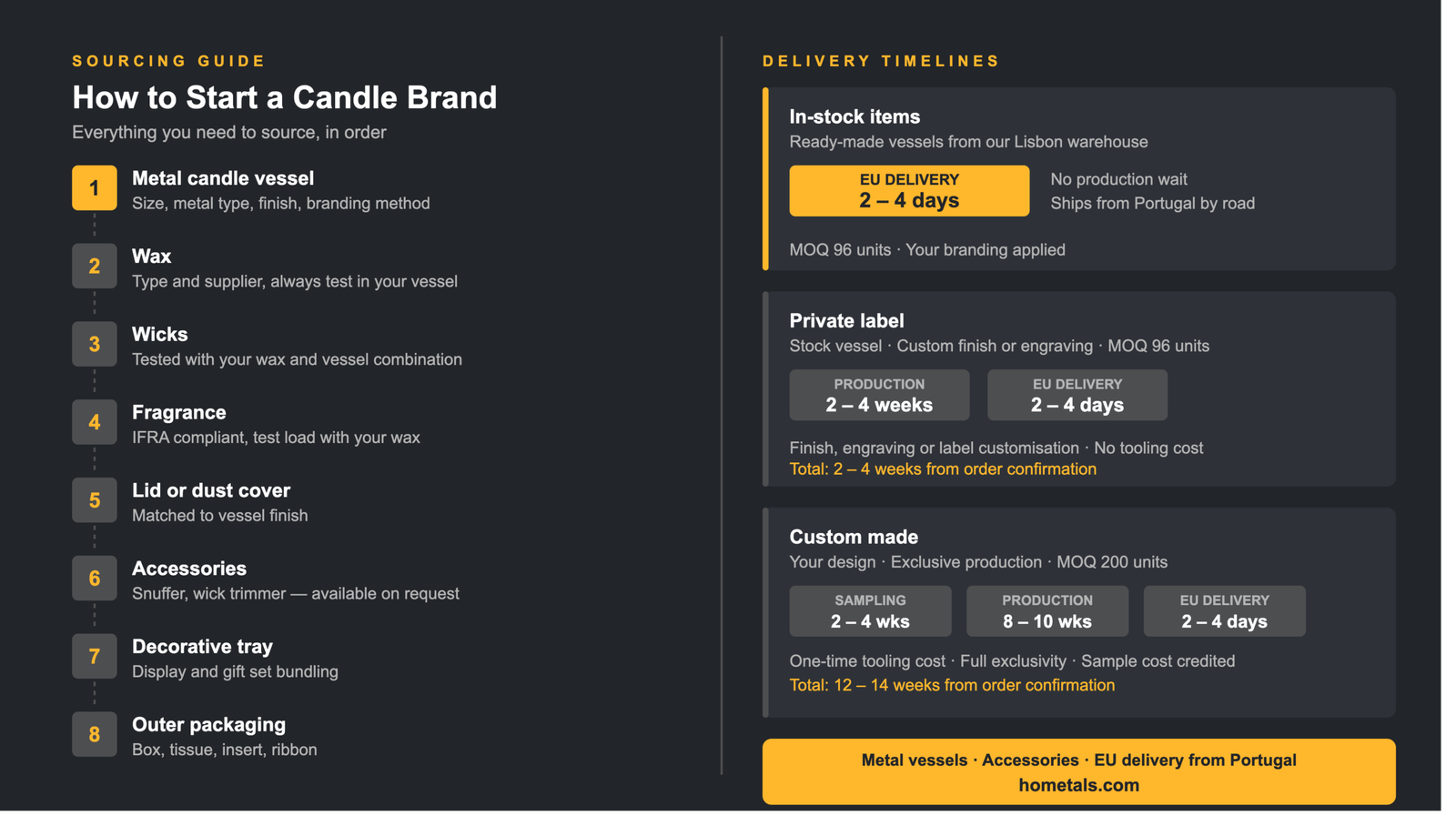
Here is everything you need to source to launch a candle brand, in order of priority.
- Metal candle vessel: size, metal type, finish, and branding method
- Wax: type and supplier, tested in your specific vessel
- Wicks: size and type, tested in your wax and vessel combination
- Fragrance: type, load percentage, IFRA compliance confirmed
- Lid or dust cover: matched to vessel finish
- Accessories: snuffer and wick trimmer if building a gift set
- Decorative tray: for display and gift set bundling
- Outer packaging: box, tissue, insert, ribbon
- Labels or engraving: branding applied to vessel
Do not try to source everything at once. Start with the vessel, wax, wick, and fragrance. Get the formulation right. Then add accessories and packaging once the core product is proven.
8. Timeline: how long does it take to launch
| Stage | What happens | Time needed |
|---|---|---|
| Vessel sampling | Request and receive metal vessel samples from Hometals | 1 to 2 weeks |
| Wax and wick testing | Test wax and wick combinations in your vessel | 3 to 4 weeks |
| Fragrance testing | Test fragrance performance in your wax and vessel | 2 to 3 weeks |
| Label or engraving approval | Confirm branding on vessel | 1 to 2 weeks |
| First production order | Vessel production and delivery from Lisbon | 4 to 6 weeks |
| Filling and packaging | Fill, label, package, and quality check | 1 to 2 weeks |
| Total from first sample request | 12 to 19 weeks |
Twelve to nineteen weeks is a realistic timeline for a first launch done properly. Brands that rush testing to go faster almost always encounter quality issues at scale that cost more to fix than the time they saved.
Hometals supplies metal candle vessels, decorative trays, and candle accessories from Lisbon. Brass, copper, and steel. Surface treated for fragrance compatibility. White label from 96 units. Private label from 200 units. Snuffers, wick trimmers, and matching accessories available on request. To request samples or discuss your range, visit hometals.com or write to jorge@hometals.com.
Published by Hometals hometals.com jorge@hometals.com +351 916 790 064
Author

Jorge Alves is Brand Manager at Hometals, leading client relationships and marketing across Europe. Working directly with the Hometals operations team in Portugal, Jorge helps home décor brands, candle makers, and hospitality buyers source custom metal accessories. From private label brass candle jars to bespoke copper trays - manufactured to specification and delivered EU-ready from Lisbon.